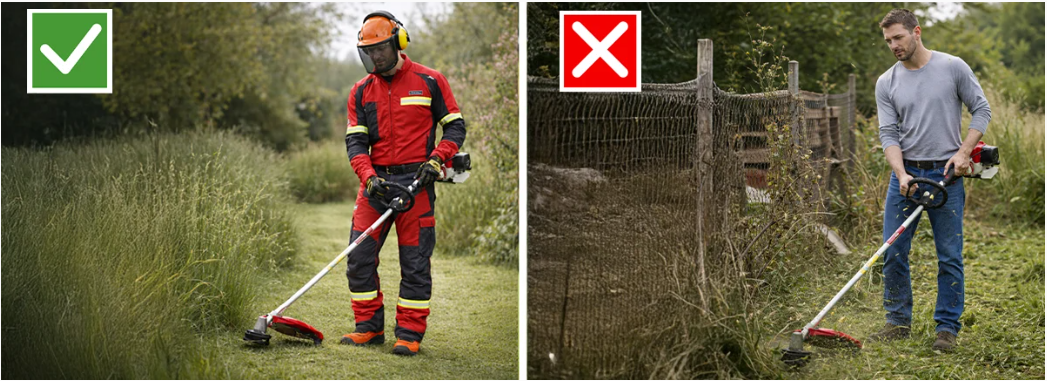
Complete guide to the proper use of brush cutters: what to do and what to avoid before and during operation, and how to handle unexpected situations.
The brush cutter is one of the most frequently used machines for mowing grass, cleaning ditches and embankments and cutting weeds where a lawn mower cannot work. Thanks to its versatility, it is often used in very different conditions, with soft grass, brambles, scrub, and dense vegetation.
Using the brush cutter correctly is not only about achieving a cleaner cut. It also means preserving the engine, transmission, bevel gear and cutting head over time, reducing vibration, overheating and limiting breakdowns.
This guide provides a practical comparison of what to do and what to avoid in the most common situations, with the aim of maximising performance and the machine’s service life.
CONTENTS
How should this guide be used?
Since many problems depend on operational errors, it is useful to clarify what the purpose of this guide is and how to use it properly. Here you will find practical, general advice on how to use a brush cutter correctly, explained in a straightforward way to help you quickly build a solid foundation of knowledge, especially if you are a beginner.
However, it does not replace the manufacturer’s instruction manual. The manual, in fact, is a more technical and comprehensive document, as it contains the machine’s specific features, controls, correct operating procedures, and above all, all the safety rules that must be read, understood, and followed during use. This guide should therefore be regarded as a supplement to the manual: it offers additional advice and general guidance, but the main reference should always remain the product documentation.
Now that the purpose of this guide has been clarified, we can move on to the practical part: let us examine what should be done and what should be avoided in order to use the brush cutter methodically, achieve cleaner cuts, and minimise effort, wear, and unforeseen issues!
1. Pre-operational preparation
Before starting to use the brush cutter, it is useful to carry out a quick general check of the machine: check that all screws are tight, the handles are stable and the guards are correctly fitted.

1.1 Checking the cutting system
The line or disc is the point of direct contact between the brush cutter and the vegetation. They are therefore the components subjected to the greatest stress during cutting and those that have the greatest impact on cut quality, vibration levels, and load on the transmission. If they are not in proper condition, the rest of the machine will operate less efficiently, with increased wear and reduced performance.

- What to do: check that the line head or disc is fitted correctly and tightly, ensuring that the line has the appropriate length and diameter for the model. Pay attention also to the integrity of the protective guard and the lin-cutting blade, which is designed to automatically maintain the correct line length during operation.
- What to avoid: starting work with excessively worn line, line that is too short, or with a bent or chipped blade.Under these conditions, the cut becomes uneven, there is a tendency to increase engine speed to compensate for reduced efficency, and vibrations are generated which, over time, may damage the bearings and the drive shaft.
Tip: Always use line of the diameter specified in the manufacturer’s manual. A line that is too large stresses the engine and reduces performance, while one that is too thin wears out quickly and requires frequent feed.
1.2 Checking and greasing the bevel gear
The bevel gear is one of the most important parts of the brush cutter, as it transmits motion from the engine to the cutting head. Proper lubrication reduces friction, overheating and wear, ensuring smoother operation and a longer transmission service life.
- What to do: check the grease level in the bevel gear and, if necessary, lubricate it using the appropriate grease nipple, following the manufacturer’s instructions. Use specific transmission grease and add it regularly, especially in the case of frequent or prolonged use.
- What to avoid: using the machine with a poorly lubricated or completely dry bevel gear. Under these conditions, friction and temperatures increase rapidly, resulting in gear wear and the risk of transmission damage.
1.3 Correct preparation of the fuel mixture
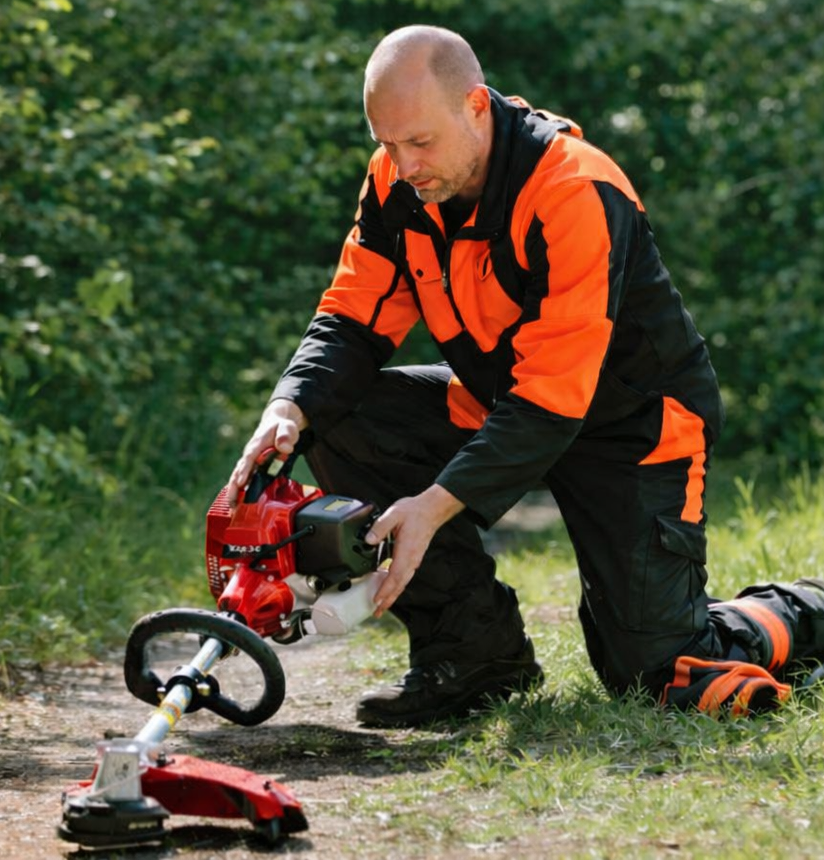
Correct mixture preparation is crucial for the smooth running of the two-stroke brush cutter engine. A well-balanced mixture of quality fuel ensures adequate lubrication of internal parts, keeps the engine running smoothly and enables consistent performance.
Neglecting this aspect may lead to starting difficulties, sudden drops in power, and, over time, more serious issues affecting the carburettor or electrical components.
- What to do: use freshly prepared mixture in the correct proportions specified by the manufacturer and store it in clean, suitable canisters. Before starting work, check the level in the tank and avoid running out of fuel during cutting.
- What to avoid: using old or long-prepared mixture. Degraded fuel loses some of its properties and may cause starting difficulties, irregular operation, and the formation of deposits in the carburettor. An altered fuel mixture also compromises proper engine lubrication and, in more serious cases, may lead to seizure.
Tip: Prepare only the amount of fuel mixture required for a limited period and avoid storing it for extended lengths of time. Careful fuel management is one of the simplest actions to ensure reliability, consistent performance and a longer service life for your brush cutter.

1.3.1 How long the mixture lasts and how to store it
The mixture for two-stroke engines tends to degrade over time, losing some of its lubricating and combustion properties. In fuels containing ethanol, moisture can also promote the separation of petrol and oil, making the mixture less uniform and less effective.
This is why it is advisable to prepare only the quantity required for short-term use and to consume it within approximately 30 days.
The fuel mixture should be stored in a suitable canister, tightly sealed and stored in a cool, dry place away from heat sources, in order to maintain reliable starting and consistent operation over time.
If the machine struggles to start after a period of non-use, it is always a good idea to check the quality of the fuel mixture first.
1.4 Harness adjustment
Correct harness adjustment allows the weight to be evenly distributed and the cutting head to be maintained at the correct height without effort, improving cut quality and stability during operation.

- What to do: adjust the harness so that the machine is well balanced and the cutting head remains at the correct height above the ground without having to support the weight with your arms. The machine should effectively “rest” on the harness, allowing for smooth and controlled movements. This reduces fatigue, improves cutting precision, and limits the vibrations transmitted to the machine structure.
- What to avoid: working without a harness or with badly adjusted straps. In these conditions one tends to compensate with incorrect postures and poorly controlled movements, increasing fatigue and vibration. Over time this leads to less precise use of the machine and greater stress on the shaft and transmission, with possible premature wear.
2. Correct use during cutting
The way in which the brush cutter is used has a decisive impact on the quality of the results, fuel consumption, and the service life of the machine. It is not just a matter of ‘cutting the grass’, but of doing it right, keeping the engine at the correct working speed and minimising stress on the transmission, clutch and cutting components.
Proper use allows for more even cutting, reduces operator fatigue, and helps prevent issues such as overheating, abnormal vibrations, and premature wear of the line or blade.

In the following chapters, we examine what to do and what to avoid during cutting, analysing the most common situations that directly affect efficiency and reliability.
2.1 Cutting technique and movement
Cutting technique is one of the most underrated aspects of brush cutter use. Correct movement not only makes cutting more even and precise, but also reduces the strain on the engine and transmission. Conversely, abrupt or forced movements generate load peaks which, over time, affect the clutch, bevel gear, and drive shaft.
Learning to ‘let the machine do the work’ is the first step towards achieving consistent performance and a longer service life.
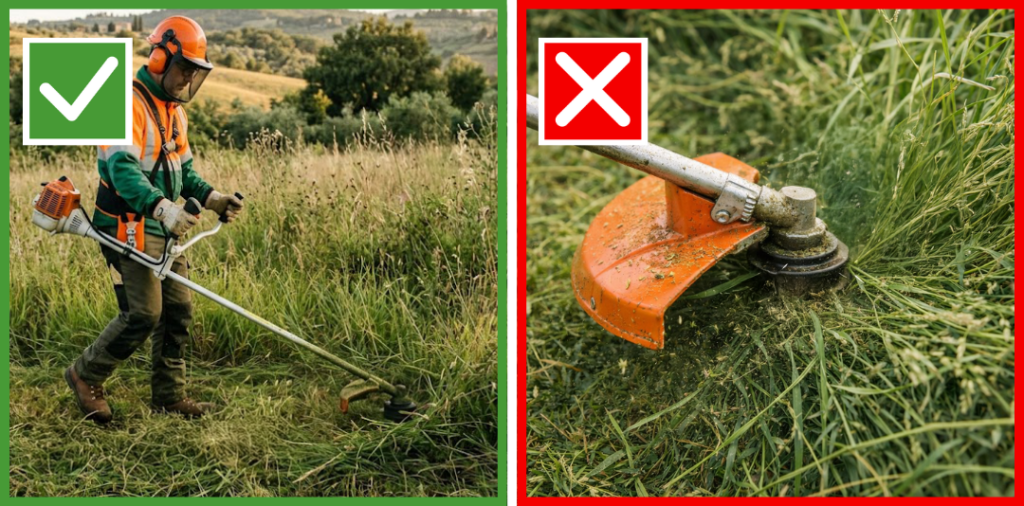
- What to do: maintain a stable posture, making a wide, regular movement from right to left. Let the engine speed do the work, driving the machine without forcing it. This allows progressive cutting and limits load peaks on the transmission.
- What to avoid: pushing the cutting head against vegetation or using the brush cutter as if it were a front blade. Forcing forward movement causes overload, increased fuel consumption, and overheating of the clutch and internal components, reducing the machine’s service life.
If you notice that the engine ‘struggles’ or drops in rpm during movement, reduce forward motion rather than increasing pressure. Adjusting the working pace to the type of vegetation improves efficiency and helps preserve the brush cutter’s mechanical components.
Important: Keep the head a few centimetres above the ground, with a steady, controlled movement.
2.1.1 Cutting technique on sloping terrain
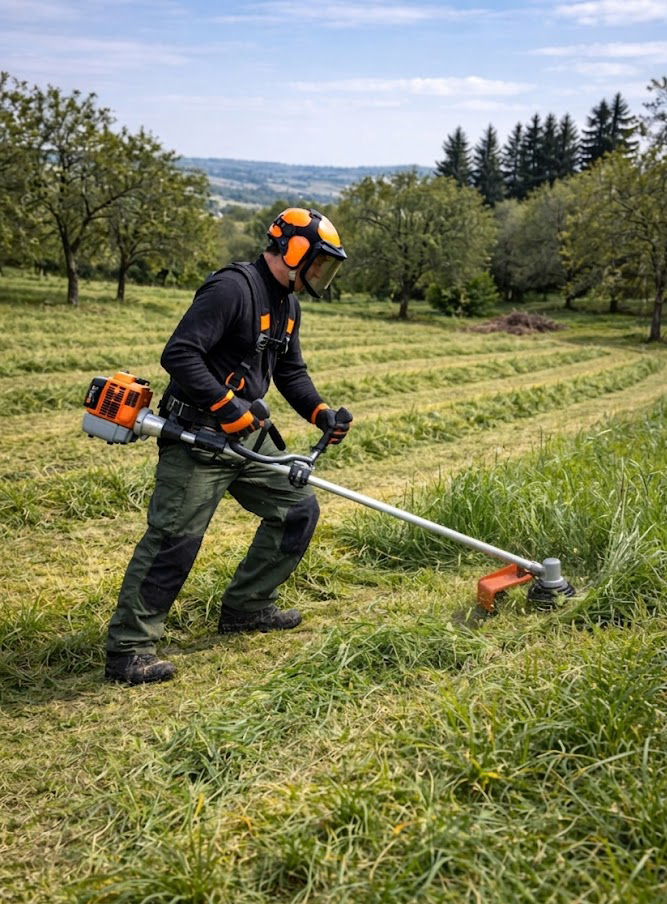
When working on a slope with the brush cutter, the first thing to do is to maintain a stable position.
On sloping ground, it is not only important to achieve a good cut, but also to maintain full control of the machine at all times, avoiding forced movements or loss of balance:
- What to do: work across the slope, following the contour of the ground and keeping the cutting head as level as possible relative to the ground.
This allows better control of the machine, keeping the head at the right height and achieving a more even cut, reducing strain and stress on the transmission. - What to avoid: working uphill or downhill along the line of maximum slope. This results in reduced stability, more fatigue and a tendency to work with irregular movements, increasing the risk of errors, impacts and uneven cutting.
Tip: On steeper slopes, it is best to work in small sections, completing a narrow strip before moving sideways. Attempting to make overly wide passes or advancing too quickly can easily lead to a loss of control and increased fatigue.
2.1.2 Cutting technique in the presence of obstacles
When working near obstacles such as walls, fences or trees, the control of the brush cutter becomes even more important. In these situations it is not only important to cut, but to do so with precision, avoiding shocks that can compromise the quality of work and increase machine wear.
Proper handling results in cleaner finishes, reduced thread consumption and reduced stress on the head, transmission and internal components.
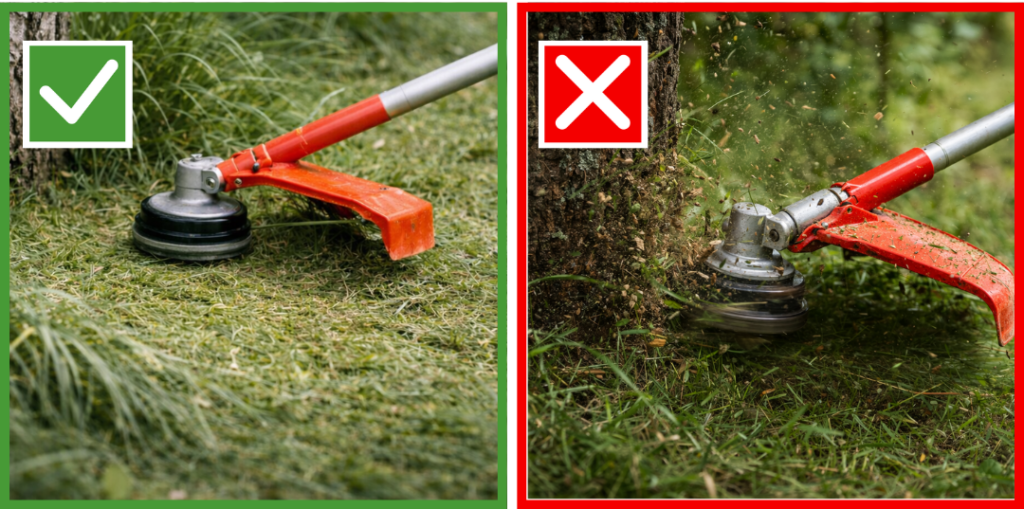
- What to do: approach obstacles progressively, reducing the range of movement and working with light, controlled passes. It is useful to decrease the feed speed slightly and focus on precision, always keeping the head under control without forcing. This allows for cleaner finishing, helps to avoid impacts, and reduces line consumption.
- What to avoid: striking hard obstacles such as stones, posts or kerbs directly, or working too quickly in finishing areas.
Repeated impacts generate vibrations, accelerate line wear, and may damage the cutting head or place stress to the transmission. Moreover, an overly aggressive approach reduces precision and often requires multiple passes over the same area.
Tip: When the area contains many obstacles, it is advisable to carry out general cutting first and then perform finishing separately, using shorter, more controlled movements. This improves the end result and reduces stress on machine and operator.
2.2 Managing tall or very dense grass
Very tall grass, dense vegetation or tougher weeds require a different approach compared to routine maintenance cutting. Under these conditions, the load on the machine increases significantly, and incorrect handling can lead to low revs, excessive line consumption and engine overheating.
What to do then in these cases?
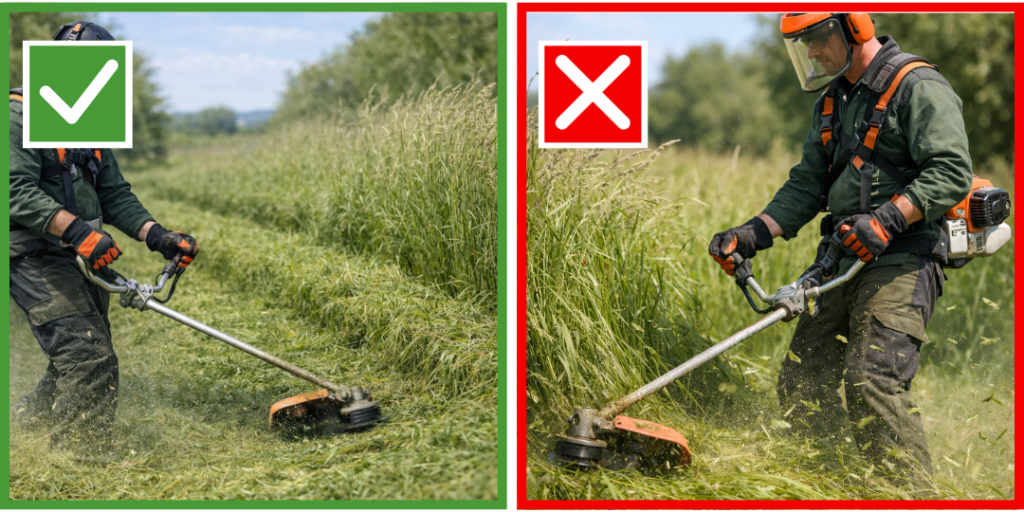
- What to do: working in several passes, gradually reducing the height of the vegetation. It is advisable to start from the upper part of the grass and then work down towards the base with steady movements. This allows the engine to maintain a more stable speed, avoids excessive build-up of material around the cutting head, and reduces the risk of blockages or sudden slowdowns.
- What to avoid: attempt to cut the entire height of the grass in a single pass, sinking the head to the base right from the start. This leads to excessive and continuous load on the engine, leading to a drop in speed, increased operating temperature, and greater line wear.
2.3 Engine speed and control
The engine speed determines how the brush cutter transfers power to the cutting system. Working at a stable engine speed suited to the vegetation allows for a clean cut, reduces vibrations, and limits stress on the clutch, transmission, and bevel gear. Conversely, frequent changes in engine speed or prolonged use at maximum revs increase fuel consumption and temperatures, accelerate wear of the cutting components, and, over time, reduce the machine’s performance.
- What to do: maintain an appropriate and as constant as possible engine speed during cutting, modulating the throttle progressively and without sudden changes. The aim is to ensure continuous operation of the cutting head, preventing the engine from “bogging down” under load or fluctuating constantly in speed.
- What to avoid: constantly working at full speed even when not necessary, especially on light grass or when trimming. Under these conditions, fuel consumption, noise and vibrations increase unnecessarily, and the line wears out more quickly without any real improvement in the result. Similarly, avoid repeated throttle surges to ‘force’ the cut: these surges create unnecessary stress on the transmission and make work less controlled and less precise.
3. What to do if something goes wrong?
During use of the brush cutter, issues such as abnormal vibrations, loss of power, a jammed cutting head, or line that fails to advance and eventually breaks may occur. Even with proper use, these situations can happen and must be handled properly to avoid damage to the machina.
The difference lies in how one reacts. The general rule is always the same: stop the machine, switch off the engine or switch off the power supply before carrying out any checks.

In the following paragraphs, we outline what to do and what to avoid in the most common situations, in order to protect the brush cutter’s service life, maintain high performance, and work with greater confidence.
3.1 Abnormal vibrations
Abnormal vibrations are one of the most obvious signs that something is not working properly.
A brush cutter in good condition, with a well-balanced and correctly fitted cutting element, should produce limited and regular vibrations.
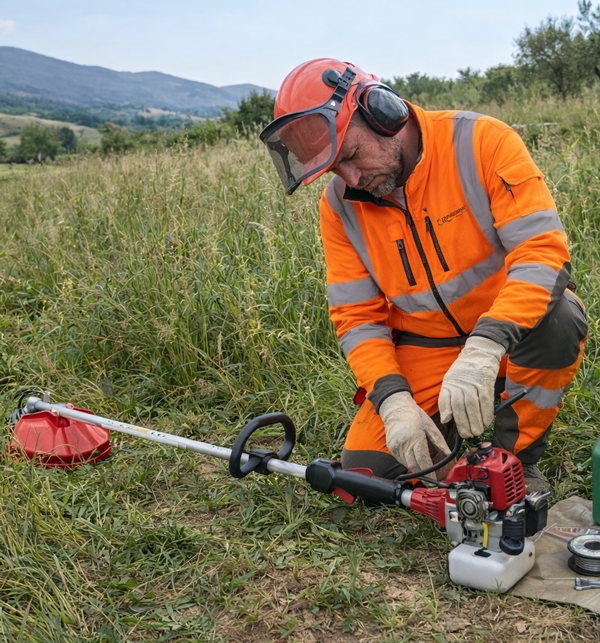
When vibrations increase suddenly or become irregular, this is almost always a sign of imbalance or a mechanical issue.
How should you proceed if abnormal vibrations are detected in the brushcutter?
- What to do: check the condition of the line head or blade, ensuring that they are not damaged, correctly fitted and free from deformation or damage. Also check that the line is inserted evenly on both sides. In most cases, vibrations are in fact linked to an imbalance in the cutting element.
- What to avoid: continuing to work while ignoring vibrations, or attempting to compensate by gripping the handle more tightly. Prolonged stresses can damage bearings, internal transmission and machine couplings, resulting in more complex and costly repairs.
Tip: If vibrations persist after checking the line head or blade, stop using the machine and have it inspected. Continuing to operate with unresolved vibrations may compromise internal components that are not easily visible but are essential to the brush cutter’s durability.
3.2 Power drops
A drop in power is a sign that the brush cutter is not working under optimum conditions. It may manifest as difficulty in maintaining engine speed under load, less effective cutting, or the sensation that the machine is “struggling” even with relatively light vegetation.
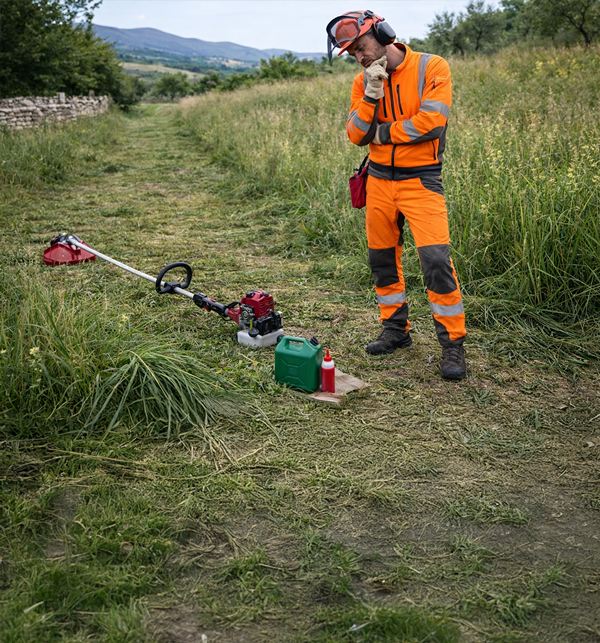
In most cases, this is not a serious fault, but rather an issue related to blockages, material build-up, or incorrect fuel supply.
- What to do: check for of grass or debris build-up around the head and under the protective guard, check that the air intakes are clear and, in petrol models, erify the condition of the air filter and the quality of the fuel. An obstruction or dirty filter restricts the proper air flow to the engine, altering combustion and reducing performance.
- What to avoid: compensating for power loss by continuously operating at full throttle, or persisting in very dense vegetation without adapting the cutting technique. This behaviour increases the operating temperature, accelerates transmission wear and does not address the underlying cause of the problem.
Working under these conditions can turn a simple build-up of residue into overheating or more serious damage.
Tip: If the power loss occurs repeatedly, consider whether the model in use is suitable for the type of vegetation. Using an unsuitable cutting element may force the machine to operate under constant strain, reducing performance and long-term durability.
3.3 Jammed cutting head or line not feeding
During work, it can happen that the head jams or the line does not come out correctly. This problem is often related to grass or dirt build-up, or improper loading of the line within the cutting head.
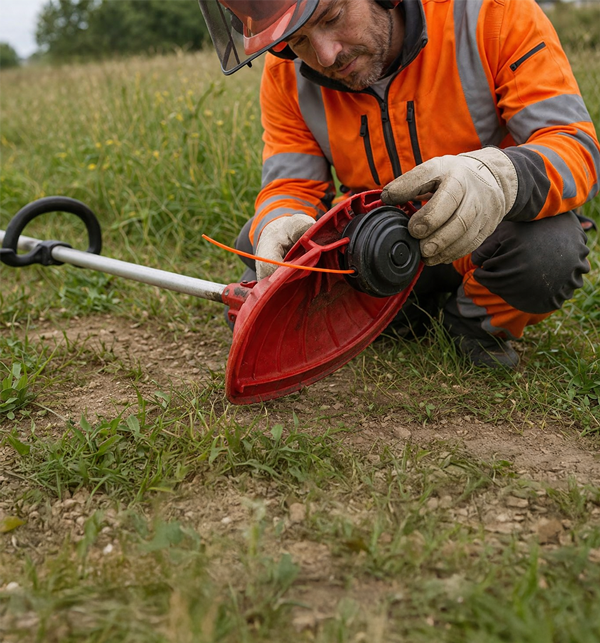
- What to do: stop the machine and wait for it to come to a complete stop before intervening. Check that there is no buold-up of grass or debris around the head and clean it if necessary.
Also check that the ine is correctly wound and not jammed or overlapping within the spool. - What to avoid: continuing to work by forcing the head or repeatedly hitting the ground in an attempt to get the line out when the mechanism is locked.
This behaviour can damage the cutting head, increase vibration and transmit unnecessary stress to the transmission.
3.3.1 What if the line breaks?
In most cases, this issue does not stem from a fault in the machine, but from use that is not suited to the cutting conditions or from the selection of a line that is not appropriate for the type of vegetation:
- Very dense grass, more resistant weeds, the presence of stones, kerbs or other rigid obstacles may in fact subject the line to excessive strain, accelerating its wear or causing it to break.
- Working technique also has a great influence. When working with excessively abrupt movements, cutting too close to the ground, or frequently striking hard surfaces, the line can no longer cut effectively and tends to break.
Tip: In some cases, especially if the line has been stored for a long time or in very dry environments, it may become more brittle and prone to breaking. Restoring proper elasticity, for example by leaving it in water for a few hours before use, helps to improve its strength and reduce breakage during work.
4. PPE and safety clothing
The use of a brush cutter involves the risk of stones and debris being thrown, exposure to high noise levels, and contact with dense vegetation, sometimes thorny or woody. Even during seemingly simple cutting tasks, material may rebound or the machine may strike objects hidden in the ground.
Wearing appropriate personal protective equipment not only helps prevent injuries, but also allows for greater concentration and control, reducing distractions and interruptions. Proper protection also contributes to continuity of work and overall satisfaction when using the machine.

- Eye and face protection is indispensable: Wraparound protective goggles or, better still, a full face visor protect against stones, splinters and vegetation fragments. Without adequate protection, even a small piece of debris can cause injury and interrupt work.
- Hearing protection: Strongly recommended, especially for petrol-powered models. Ear muffs or ear plugs reduce prolonged exposure to noise and help maintain concentration and comfort during cutting.
- Clothing must be tight-fitting but durable, avoiding loose garments that can get entangled. When working in dense vegetation, thick trousers or specific leg protection are recommended.
- Footwear must be sturdy, closed and with a non-slip sole. Lightweight or open footwear exposes the operator to risk in the event of impacts with debris or loss of balance on uneven ground.
For correct use of the brush cutter, it is always necessary to consult the manufacturer’s instructions manual and to comply with current regulations, using all the safety devices provided with the machine. Proper protection contributes not only to personal safety, but also to more precise and continuous work, with greater satisfaction over time.